
Key Takeaway
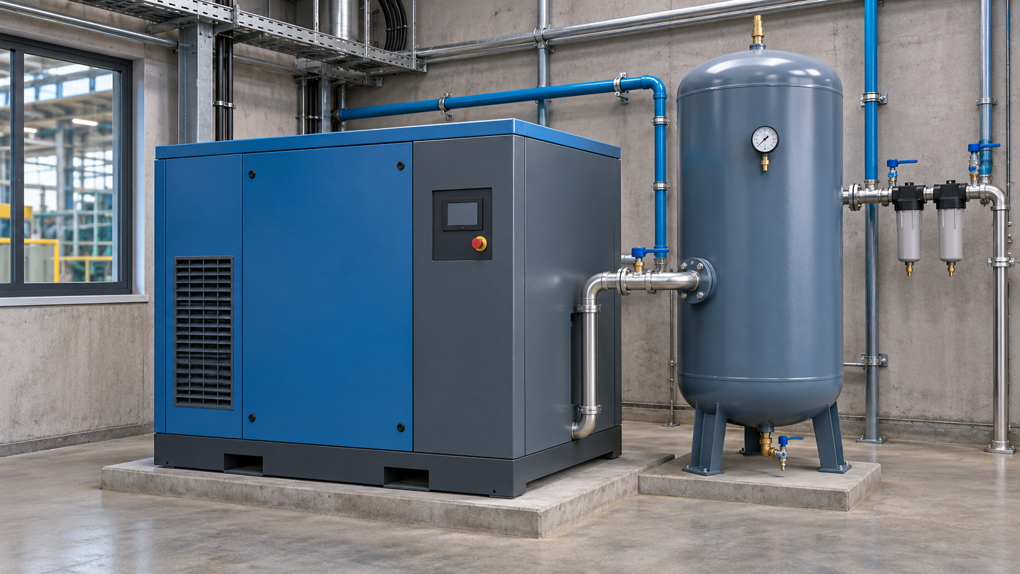
What size air compressor do I need? Start with the airflow (CFM) your equipment uses when it runs together and the pressure (PSI) it needs at the point of use. Account for pressure losses through piping, dryers, and filters. The worked example below shows how a shop with 17 CFM of simultaneous demand arrives at a preliminary target of 21.25 CFM at 100 PSI. Use the same method to compare compressor ratings, then check whether each model can support your operating schedule. Compressed Air & Gas Institute sizing guide
How to Calculate the Air Compressor Size You Need
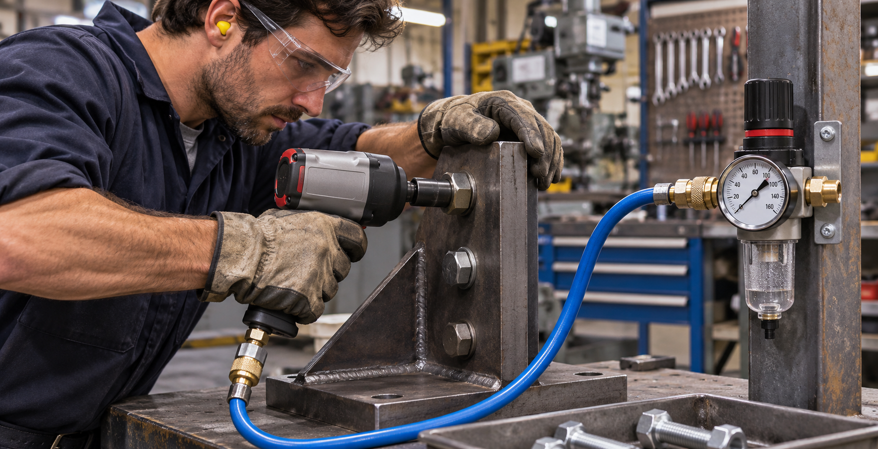
1. Record each tool’s airflow and pressure requirements
For every tool or machine, record its airflow in cubic feet per minute (CFM), minimum inlet pressure in pounds per square inch (PSI), and typical run time. Check whether the manufacturer lists airflow while the tool is running or average consumption over an assumed duty cycle. Use ratings on a consistent basis when adding demand. CAGI sizing guide
2. Add the airflow of equipment that runs together
Identify which tools can operate at the same time and add their airflow requirements. In this illustrative workshop example, all four tools are drawing air at the listed rates.
| Equipment | Units running | Airflow per unit | Total airflow |
|---|---|---|---|
| Impact wrench | 2 | 5 CFM | 10 CFM |
| Air ratchet | 1 | 4 CFM | 4 CFM |
| Blow gun | 1 | 3 CFM | 3 CFM |
| Total | 4 | 17 CFM |
With a 25% allowance for this example, the preliminary airflow target is 17 × 1.25 = 21.25 CFM. Base your actual allowance on factors you can estimate, such as air leakage and planned equipment additions. If you already have a compressed air system, log airflow and pressure over a representative operating cycle to see how often demand peaks and how long those peaks last. CAGI sizing guide · Atlas Copco guide to measuring air demand
3. Work back from the pressure each tool needs
For each tool, add its minimum inlet pressure to the expected pressure drop along its supply path at the design flow. Include losses through piping, dryers, filters, and other components in that path. Use the highest resulting discharge pressure requirement for the shared system. CAGI compressed air sizing FAQ
In the workshop example, assume the most demanding supply path serves a tool that needs 90 PSI and loses 10 PSI along the way. The compressor needs to supply 100 PSI, giving the shop a preliminary comparison point of 21.25 CFM at 100 PSI.
4. Compare compressor ratings at your required pressure
Use the manufacturer’s delivered airflow at the required discharge pressure to shortlist models. Horsepower describes motor power, while receiver volume describes how much compressed air the tank can store. An air receiver can support brief demand spikes, and the compressor needs enough time between spikes to recharge it. Atlas Copco compressor selection guide · Atlas Copco guide to measuring air demand
Before selecting a model, check its duty-cycle rating against your operating schedule. For an industrial installation, also confirm performance at your site’s temperature and altitude, the required air quality, and how much capacity you need during maintenance or an outage. CAGI compressed air sizing FAQ
Piston vs. Rotary Screw Compressors
| Demand pattern | Configuration to evaluate | What to check |
|---|---|---|
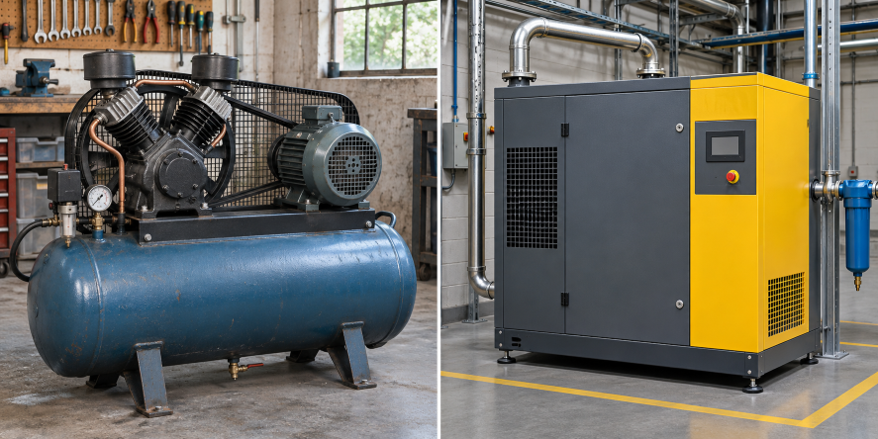
| Intermittent use in a garage or workshop | Piston compressor | Duty cycle and recovery time between periods of use |
| Sustained demand on a production line | Rotary screw compressor | Delivered CFM at the required pressure over the operating shift |
| Demand that varies significantly across shifts | A variable-speed unit or a staged system with fixed-speed and variable-speed units | How the system handles low demand, peak demand, and a unit going offline |
Use your operating profile to narrow the options. A repair shop with several technicians using air tools at once can have a very different demand pattern from a shop where one technician uses air intermittently. CAGI compressed air sizing FAQ · Atlas Copco guide to sizing for variable demand
Industrial Case Study — Replacing Four Piston Compressors at Futamura
At Futamura’s cellulose film plant in Wigton, UK, the existing system used four aging piston compressors. The project team logged compressed air demand and used KAESER’s Energy Saving System to model the existing setup. The model estimated baseline electricity use at more than 2.5 million kWh per year, with annual electricity costs of approximately £250,000. Futamura selected three KAESER rotary screw compressors and a central controller. KAESER’s Futamura case study
If you’re replacing a plant system, give suppliers your logged demand profile. Ask them to show which compressors would run on a typical shift, how the system would respond to peaks, and how much capacity would be available with a unit offline. CAGI sizing guide
Frequently Asked Questions
Can a bigger air tank make up for a smaller compressor?
A larger receiver can supply extra air during a short spike. If demand stays above the compressor’s output, the stored air will run down and system pressure will fall. Size storage around the duration and frequency of short peaks. Atlas Copco guide to measuring air demand
Do I add the PSI requirements of multiple tools?
Use the highest supply pressure required by any tool after accounting for pressure losses on its path. Add the CFM of tools that run together to calculate simultaneous airflow demand. CAGI sizing guide
How much extra compressor capacity should I allow for growth?
Estimate the airflow, pressure, and hours of use for planned equipment. If the timing or scale of expansion is uncertain, compare the cost of installing spare capacity now with a system you can expand later. CAGI compressed air sizing FAQ
Find the Right Air Compressor With GiantAir
Contact GiantAir with your equipment list, required CFM and PSI, and a typical operating schedule. If you’re replacing a system, include any logged airflow and pressure data, along with planned expansion and backup requirements. These details will help GiantAir discuss compressor capacity, air treatment, and whether a single unit or a multi-compressor system fits your operation.